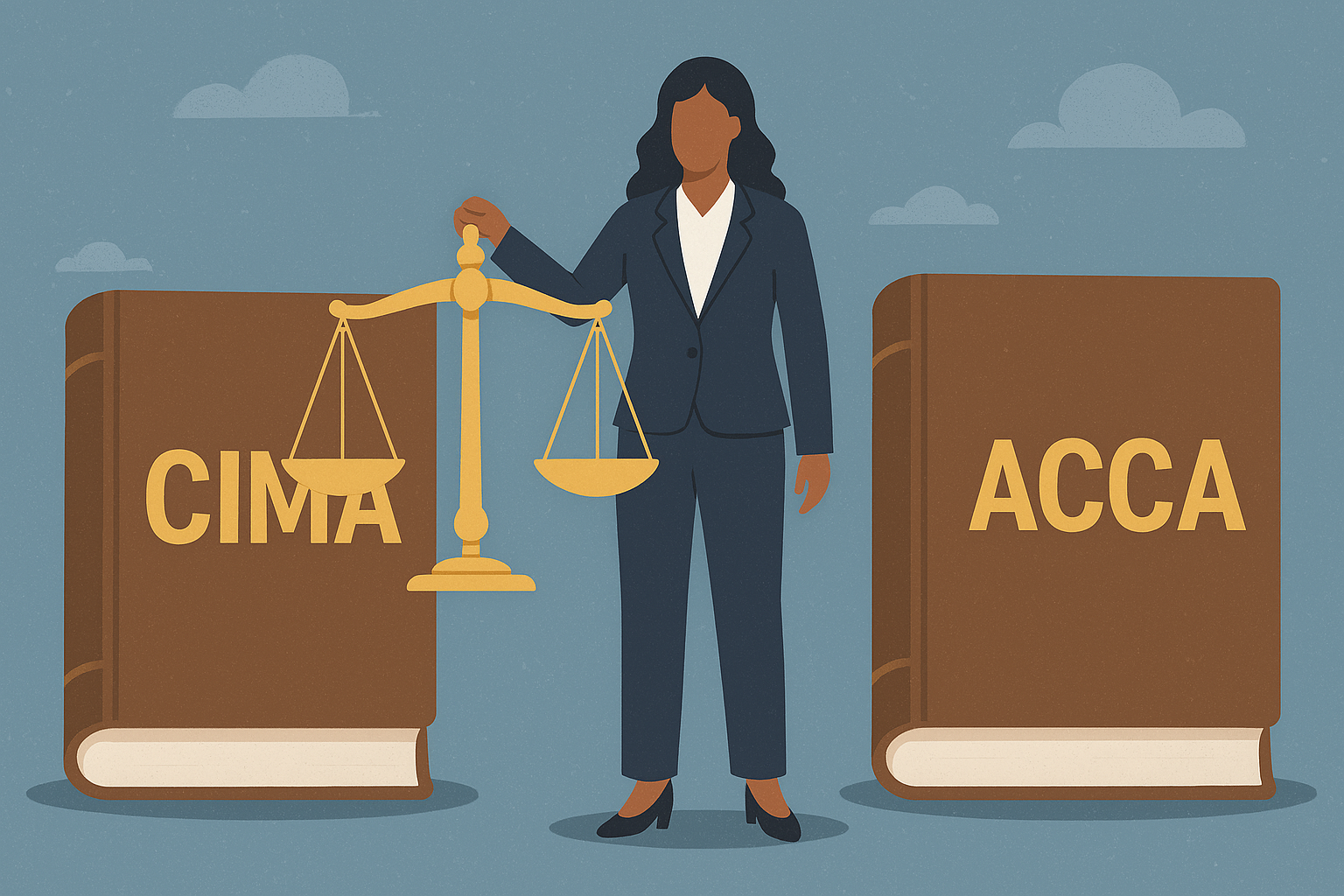
Deciding on the right professional accounting qualification is one of the most critical career choices you will make. For those aspiring to reach the highest levels of finance and business, the choice often comes down to two globally recognized powerhouses: the Chartered Institute of Management Accountants (CIMA) and the Association of Chartered Certified Accountants (ACCA). While both qualifications open doors to prestigious careers, they are fundamentally different in their focus, curriculum, and the career paths they are designed to support.
This comprehensive comparison will break down the core differences between CIMA and ACCA, helping you understand which qualification aligns best with your professional ambitions, whether you aim for a strategic management role or a career in public practice.
Core Philosophy: Management vs. Financial Accounting
The most significant difference between CIMA and ACCA lies in their core focus, which dictates the entire curriculum and the type of professional they aim to create.
CIMA: The Management Accountant
CIMA is focused on Management Accounting. Its curriculum is designed to train professionals who will work within a business, using financial data to inform strategic decisions, manage risk, drive performance, and create value. CIMA professionals are often found in roles such as Financial Controller, Management Consultant, and Chief Financial Officer (CFO).
CIMA’s Focus: Forward-looking, strategic, value creation, internal decision-making, and business performance.
ACCA: The Financial Accountant
ACCA is focused on Financial Accounting and Public Practice. Its curriculum is designed to train professionals who will work in roles that require external reporting, auditing, and taxation. ACCA professionals are typically found in roles such as Auditor, Tax Consultant, Financial Reporting Specialist, and often work in public accounting firms.
ACCA’s Focus: Backward-looking, compliance, external reporting, auditing, and tax.
Curriculum and Examination Structure
The difference in philosophy is clearly reflected in the structure and content of the exams.
|
Feature
|
CIMA (Chartered Institute of Management Accountants)
|
ACCA (Association of Chartered Certified Accountants)
|
|
Total Exams
|
16 (12 Objective Tests + 4 Case Study Exams)
|
13 (or 14, depending on exemptions)
|
|
Levels
|
Certificate, Operational, Management, Strategic
|
Applied Knowledge, Applied Skills, Strategic Professional
|
|
Core Focus
|
Strategic decision-making, risk management, business analysis, performance management.
|
Financial reporting (IFRS/GAAP), auditing, taxation, corporate law.
|
|
Exam Format
|
Computer-based Objective Tests (on-demand) and Case Study Exams (four times a year).
|
Computer-based exams (on-demand for lower levels, set sessions for higher levels).
|
|
Final Exam
|
Strategic Case Study Exam (integrates all three pillars).
|
Strategic Business Leader (SBL) and Strategic Business Reporting (SBR).
|
|
Designation
|
CGMA (Chartered Global Management Accountant)
|
ACCA Member
|
Career Paths and Job Roles
The qualification you choose will naturally steer your career toward specific sectors and roles.
Career Paths for CIMA Professionals
CIMA professionals are business leaders who specialize in finance. They are integral to the strategic management team.
•Industry: Commerce, Manufacturing, Technology, and Public Sector.
•Typical Roles: Management Accountant, Financial Analyst, Financial Controller, Business Partner, Chief Financial Officer (CFO).
•Key Skillset: Budgeting, forecasting, risk analysis, strategic planning, and performance measurement.
Career Paths for ACCA Professionals
ACCA professionals are experts in external financial matters and compliance. They are essential for ensuring transparency and regulatory adherence.
•Industry: Public Practice (Audit Firms), Financial Services, and multinational corporations with complex reporting needs.
•Typical Roles: External Auditor, Tax Consultant, Financial Reporting Manager, Forensic Accountant, and roles requiring a Practicing Certificate.
•Key Skillset: Auditing standards, IFRS/GAAP, corporate tax, financial statement preparation, and corporate governance.
Exemptions and Entry Requirements
Both qualifications offer exemptions based on prior academic achievements, such as a relevant university degree.
•CIMA: Graduates with a relevant degree (e.g., Accounting, Finance) may receive exemptions from the Certificate Level and potentially some Operational Level papers.
•ACCA: Graduates with an accredited degree can receive up to nine exemptions, allowing them to start directly at the Applied Skills level.
It is crucial to check the official exemption calculator on the respective body’s website to determine your starting point.
Global Recognition and Membership
Both CIMA and ACCA are globally recognized and respected, but their primary geographic strengths can differ.
•CIMA: Strong presence in the UK, South Africa, India, and the Asia-Pacific region. The CGMA designation is a joint venture with the AICPA, giving it significant recognition in the United States.
•ACCA: Truly global, with a massive membership base in over 170 countries. It is particularly strong in the UK, Europe, and emerging markets.
In South Africa, both qualifications are highly valued, making the choice more about your preferred career direction than local recognition.
Making Your Choice: Which is Right for You?
The decision between CIMA and ACCA should be based on a clear understanding of your long-term career goals.
Choose CIMA if:
•You are passionate about business strategy and management.
•You want to work inside a company, influencing decisions and driving performance.
•Your ultimate goal is a CFO or senior management role in commerce or industry.
•You prefer a curriculum that emphasizes forecasting, budgeting, and risk management.
Choose ACCA if:
•You are interested in auditing, taxation, and external financial reporting.
•You want the option to work in public practice (e.g., a Big Four firm).
•You value a qualification with the broadest global reach and recognition.
•You prefer a curriculum that emphasizes IFRS/GAAP and compliance.
How Accountants For Tomorrow Supports Both Paths
At Accountants For Tomorrow, we recognize the value of both CIMA and ACCA and provide world-class tuition for both qualifications. Our expert instructors, personalized one-on-one tutoring, and comprehensive study materials are designed to ensure your success, regardless of the path you choose.
•CIMA: Our focus is on developing the strategic thinking and case study application skills essential for the CGMA designation.
•ACCA: We provide in-depth coverage of financial reporting standards, auditing, and tax, preparing you for the rigorous professional exams.
By choosing AFT, you gain a partner committed to your success, offering the flexibility and support needed to master the demanding curriculum of either CIMA or ACCA.
Conclusion: A Strategic Career Decision
The CIMA vs. ACCA debate is not about which qualification is “better,” but which one is better for you. CIMA is the qualification for the strategic business leader, while ACCA is the qualification for the global financial expert and auditor.
Take the time to research the job roles that excite you most. If you see yourself in the boardroom making strategic decisions, CIMA is your path. If you see yourself ensuring financial integrity and compliance, ACCA is your path. Whichever you choose, Accountants For Tomorrow is ready to provide the expert guidance to turn your ambition into a reality.